
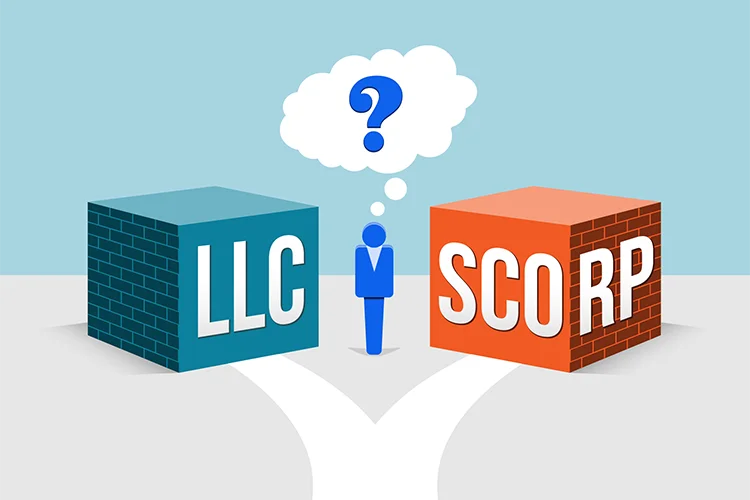
The two get pitted against each other constantly, but they’re not actually alternatives. One is a legal structure. The other is a tax election. Here’s how the decision really works.
They’re not the same kind of thing
An LLC (limited liability company) is a legal entity you form with your state. It determines your liability protection, your ownership structure, and your governance rules.
An S corporation is not a legal entity at all — it’s a tax election you file with the IRS. A corporation can elect S corp status. So can an LLC. When people ask “LLC or S corp,” what they usually mean is: should I form an LLC and leave it taxed the default way, or form an LLC (or corporation) and elect S corp tax treatment on top of it?
The real decision has two separate layers: legal structure (LLC vs. corporation, mostly about liability and formalities) and tax treatment (default pass-through vs. S corp election, mostly about how self-employment tax gets calculated).
What changes with an S corp election
By default, a single-member LLC is taxed like a sole proprietorship, and a multi-member LLC is taxed like a partnership. All the profit flows to your personal return, and all of it is subject to self-employment tax — currently 15.3% covering Social Security and Medicare.
Electing S corp status changes that. You become an employee of your own business, paid a reasonable salary subject to payroll tax. Any remaining profit can be distributed to you as a dividend, which isn’t subject to self-employment tax. That gap is the entire reason people chase the S corp election.
A simplified example
Say your business nets $120,000 in profit. Taxed as a default LLC, roughly the full amount is subject to self-employment tax. Under an S corp election, you might pay yourself a $60,000 reasonable salary (payroll tax applies) and take the remaining $60,000 as a distribution (no self-employment tax). The savings come from that second half.
Where the savings actually break even
The S corp election isn’t free. It adds real, recurring costs:
- Running payroll for yourself, typically through a payroll service
- A separate business tax return (Form 1120-S) instead of a simple Schedule C
- More bookkeeping precision, since salary and distributions have to be tracked separately
- Some states charge their own franchise or entity-level taxes on S corps
Most accountants put the break-even point somewhere around $40,000–$60,000 in annual net profit, after paying yourself a reasonable salary. Below that, the extra administrative cost tends to cancel out the tax savings. Above it, the savings usually outpace the overhead — and grow the more profit you have.
| Factor | Default LLC | LLC with S corp election |
|---|---|---|
| Self-employment tax | Applies to all net profit | Applies only to your salary, not distributions |
| Paperwork | Schedule C on your personal return | Separate corporate return, payroll filings |
| Ongoing cost | Low | Payroll service + accountant time |
| Flexibility on pay | Take money out anytime | Must run a “reasonable” salary through payroll |
What “reasonable salary” actually means
This is the part people underestimate. The IRS requires the salary portion to reflect what someone doing your job would actually be paid in the market — not a token amount designed to dodge payroll tax. Setting the salary too low is the most common way S corp elections get flagged in an audit. If you can’t defend the number by pointing to comparable pay for your role, industry, and hours, it’s too low.
A simple way to frame the decision
- Start with liability protection. If you need it, form an LLC (or corporation) regardless of tax treatment — that part of the decision doesn’t depend on profit level.
- Look at consistent net profit, not revenue. One good year doesn’t justify the switch if it’s not repeatable.
- Price out the real cost of payroll and an extra tax return in your area before assuming the savings are automatic.
- Ask whether you can defend a reasonable salary for your role. If the honest number is close to your total profit, there’s little left to shelter.
- Revisit annually. The election isn’t permanent — it’s reasonable to stay a default LLC while you’re small and elect S corp status once profit clears the break-even range.
Quick self-check
- Net profit is consistently above roughly $40,000–$60,000 a year
- You can name a fair market salary for your own role without guessing
- You’re willing to run payroll and file a separate business return
- Your state doesn’t add S corp costs that erase the benefit
If most of those are true, the S corp election is worth a real conversation with an accountant. If several aren’t, staying a default-taxed LLC and revisiting next year is often the more practical call.